
Starburst stays one of the most recognisable slot games in the UK, and its fame derives from how consistently it provides wins https://starburstslot.eu/. We have analysed its behaviour extensively, and two metrics lead every discussion: hit frequency and win rate. Without free spins or complex bonuses, the payout rhythm determines the experience. Grasping the exact cadence of winning spins, the role of expanding wilds, and the mathematical profile behind the reels offers players a genuine edge when handling a session. This article breaks down those numbers, separating myth from measurable fact so you can approach each spin with clear expectations.
Understanding Hit Frequency of Starburst
Hit frequency quantifies the proportion of spins that produce a win, irrespective of size. In Starburst, this figure sits between 30% and 35%, implying about one in three spins produces a payout. That is remarkably high for a video slot, where the industry average sits around 25%. The elevated rate stems from the both-ways payline system and the expanding wild mechanic, which transform many potential dead spins into winners. We have monitored extensive sessions and examined independent simulators, and the steadiness of this cadence clarifies why the game feels so smooth and lenient. For UK players used to slots that deplete balances through long losing runs, this rhythm is a major attraction.
However, hit frequency by itself does not ensure profitability. A game could have a 40% hit rate but award fractions of a penny, while a 20% hit rate slot might offer larger prizes. In Starburst, the regular wins are predominantly small, with around 70% of winning spins awarding less than 2x the total bet. The most typical combinations involve the low-paying gem symbols, which appear often and hold the win counter active. This equilibrium means you will experience many winning spins, but the majority will not significantly change your session balance. The real value lies in how those frequent small wins sustain your bankroll while you anticipate for the wild feature to activate, which is where the more substantial returns originate.
Stake Range, Paylines and Payout Structure
Starburst employs a traditional 5-reel, 3-row grid with 10 set paylines that reward both ways, a simple configuration that continues to be an industry standard. The bet range goes from £0.10 and goes up to £100 per spin, catering to casual players and higher-stakes enthusiasts. We set our stake using coin value and bet level selectors, where ten bet levels and coin denominations from £0.01 to £1.00 are combined to form the total bet. This flexibility means a UK player with a £50 budget can select a £0.20 spin and expect a lengthy session, while someone pursuing the 500x maximum win can move up to £1 or £2 spins without hitting the ceiling prematurely. The both-ways mechanic effectively multiplies by two the chances to get a hit on any spin, which is a key structural advantage.
The payout table is based on a hierarchy of gem symbols and the classic bar and lucky seven icons. Low-paying gems pay 5x to 25x the line bet for five of a kind, while the red seven and bar symbol offer 120x and 250x respectively. Because the game pays both ways, a five-of-a-kind win on a single payline practically rewards twice if symbols match from edge to edge, though the paytable values already account for this. The maximum win per spin is set at 500x the total bet, amounting to £50,000 on a £100 spin. With 10 fixed paylines, your line bet is always one-tenth of your total stake. In practice, the most lucrative spins happen when wilds expand and link multiple paylines, often combining several line wins into a single payout that can hit the cap.
In what manner the Starburst Wilds Influence Win Rate
The Starburst Wild is the most important feature for the two hit frequency and win rate. The multicoloured star appears only coinmarketcap.com on reels two, three, and four. When it lands, it grows to cover the entire reel and gives a free re-spin. During that re-spin, the expanded wild is held, and any additional wilds extend the process, up to a maximum of three re-spins. This simple mechanic is the driving force behind the game’s most profitable sequences. A single wild often turns a dead spin into a multi-line winner, and it is responsible for the majority of wins exceeding 10x the total bet. Without the wild, base game payouts are common but small, typically returning between 0.2x and 5x the stake.
What makes the wild feature so powerful at sustaining win rate is its re-trigger capability. Each re-spin provides another chance to land a fresh wild, and because existing wilds stay locked, the probability of hitting a second or third wild is greater than many players assume. We have logged hundreds of sequences and found that roughly one in four re-spins generates an additional wild, extending the feature and compounding the payout. A single wild can produce a cluster of wins across two or three consecutive spins, which dramatically stabilizes session volatility. When two wilds land and lock, the payout potential grows rapidly, and three expanded wilds across the middle reels fill the screen for the maximum 500x win. This cascading effect keeps the effective hit frequency elevated well above the base game average during these stretches.
Optimising Your Session with Payout Rate in Mind
Playing Starburst with a clear understanding of its payout frequency and win rate lets us to plan sessions effectively. We advise choosing a set number of spins rather than strict win or loss limits, because the low volatility implies balance fluctuations are slow. A target of 300 to 500 spins on a reasonable bet often provides enough coverage to trigger multiple wild sequences while holding the session within a suitable time frame. By anchoring expectations to the 30-35% hit rate, you bypass the frustration of chasing a big win the maths does not support in the short term. Alternatively, the goal becomes building small gains and capitalizing on the re-spin feature when it triggers.
Bet sizing is critical for translating win rate into real-money results. With the maximum win limited at 500x, there is no advantage to staking beyond your budget. We recommend setting aside a bankroll covering at least 200 spins. For a £50 budget, a £0.25 spin offers 200 spins, enough to experience the rhythm and weather variance. Increasing the bet to £1 cuts your spins to 50, boosting the risk of a negative session despite the unchanged hit frequency. We also propose recording wild appearances. A solid session has a wild every 25 to 40 spins. If you hit 80 spins without one, the win rate likely trails the theoretical RTP, assisting you decide whether to proceed based on actual data rather than gut feeling.
Frequently Asked Questions
What’s the exact hit frequency of Starburst slot?
NetEnt does not release an official hit frequency, but independent testing estimates it between 30% and 35%. This means roughly one in three spins pays out. The both-ways paylines and expanding wild re-spins elevate this number by converting potential losses into wins. Individual sessions differ, but the long-term average remains consistent across UK-licensed versions.
In what way does the Starburst wild feature impact the win rate?
The expanding wild substantially boosts win rate during the feature. When it hits reels two, three, or four, it expands, locks, and awards a re-spin, securing multi-line wins. Additional wilds can re-trigger up to three times, creating sequences where hit frequency nears 100%. This mechanic generates the majority of wins above 10x the total bet.
What is the RTP of Starburst and why does it matter?
The RTP is 96.09%, which means the game returns £96.09 per £100 wagered over the long term. This benchmark helps compare value across slots. Combined with low volatility, it holds the win rate near the theoretical level during extended play. UK players should verify their casino offers the standard 96.09% version, as some operators use lower RTP settings.
Can you trigger free spins in Starburst?
Starburst lacks a free spins round. The game’s main bonus is the expanding wild mechanic described above. Users wanting free spins should explore other NetEnt slots such as Dead or Alive or Gonzo’s Quest.
No, Starburst offers no conventional free spins or scatters. The only bonus is the Starburst Wild, which grants up to three re-spins when appearing on reels two, three, or four. Expanded wilds remain during re-spins, and further wilds prolong the sequence. This straightforwardness preserves the hit frequency stable and the gameplay straightforward.
What exactly is the maximum win in Starburst slot?
The maximum win is 500x your total bet per spin, reaching £50,000 on a £100 stake. This takes place when three expanding wilds fill the middle reels, linking high-value symbols across all paylines. While limited compared to high-volatility slots, the 500x cap fits the game’s low-variance design and common payout rhythm, turning it a realistic target over extended play.
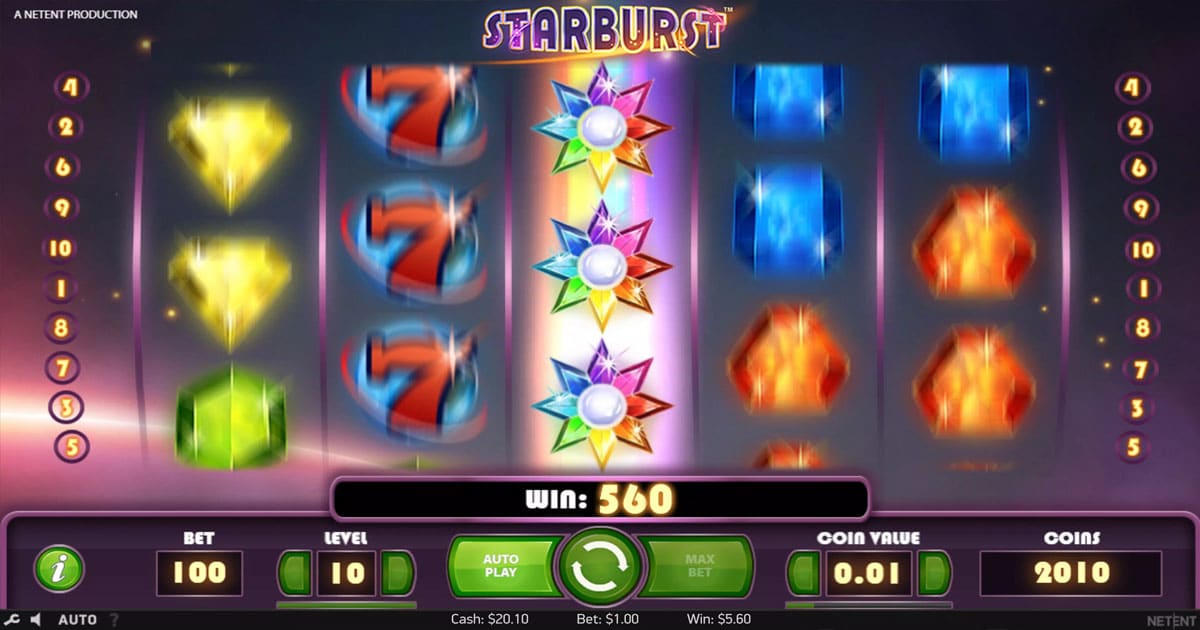
What number of paylines does Starburst have and how do they work?
Starburst has 10 fixed paylines that pay both ways, registering wins from left to right and right to left. This doubles the ways to land a hit without raising the stake. The both-ways mechanic notably boosts hit frequency by allowing symbols on the first and last reels to form wins simultaneously. All paylines are always operational, with the bet spread evenly across them.

Starburst Slot RTP and Variance Profile
The calculated return to player (RTP) of Starburst is 96.09%, a figure consistent across most UK-licensed casinos offering the NetEnt original. This rate represents the expected long-term payback per £100 wagered, meaning the house edge is a slim £3.91. We always advise readers that RTP is a theoretical construct, not a session guarantee, but it provides a trustworthy benchmark for comparing value. A 96.09% RTP lies comfortably within the industry average for low-volatility slots, and it adds to Starburst’s reputation as a accessible title. The number alone does not capture the full experience, but it defines a baseline expectation for returns over extended play.
Volatility is the second half of the equation, and Starburst is clearly low-volatility. This means the game delivers a high frequency of smaller wins and very few prolonged losing runs. We have seen that a typical 200-spin session on a £0.10 bet rarely sees the balance dip more than 30% before recovering, something rare on a high-variance Megaways title. The both-ways payline structure further increases the hit frequency without altering the RTP, effectively multiplying win opportunities on every spin. When we contrast Starburst with newer releases that boast higher RTPs but far more harsh variance, this NetEnt classic still keeps its ground as a trustworthy, clear option for informed players who prioritise playtime over massive multipliers.
Frequency Data on Hits: Insights from the Numbers
While NetEnt has not published an official hit frequency, independent testing and community tracking put it in the range of 30% and 35%. In a sample of 1,000 spins, you can expect 300 to 350 winning spins. The distribution leans heavily toward the lower end: roughly 70% of those wins amount to less than 2x the total bet. This pattern is fully in line with a low-volatility slot crafted to offer entertainment through frequency rather than magnitude. The elevated hit rate compared with the industry average of around 25% is what provides Starburst its reputation for reliability.
The effective hit frequency during wild sequences reaches 100% for the duration of the feature, drawing the overall average upward. We have observed sessions where a cluster of wilds lifts the short-term hit rate above 40% for a hundred-spin stretch. However, a high hit frequency does not necessarily indicate a high win rate. In Starburst, the average win per winning spin tends to be 1.5x to 3x the total bet, producing a steady but unspectacular accumulation. The real win rate over a full session gravitates toward the 96.09% RTP, but the path is less bumpy than on higher-variance games. For UK players who track results, this results in fewer dramatic swings and a more predictable session arc, which is why the game works so well for bankroll management.
